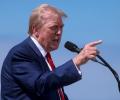
Essential and strategic items such as pharmaceuticals, semiconductors, copper, and energy products like oil, gas, coal and LNG are exempted from the 27 per cent import duty announced by the US on Wednesday, according to think tank GTRI.

The resilience of the economy and strength of domestic demand will continue to make India an engine of growth amid the rapidly evolving global trade landscape as a result of US tariffs, Finance Minister Nirmala Sitharaman said in London on Tuesday.
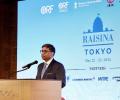
India's Foreign Secretary Vikram Misri has underscored the importance of not equating the victims and perpetrators of terror attacks, highlighting the need for global unity in combating terrorism. Speaking at Raisina Tokyo 2025, Misri expressed appreciation for Japan's support following the recent terror attack in Pahalgam, India. He also cautioned against the trend of some Western countries hyphenating India and Pakistan in the context of their recent military confrontation. Misri further outlined India's economic aspirations and its commitment to becoming a factor of stability in a turbulent world.

'But this Budget alone will not fix what ails the Indian economy.'
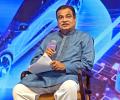
'I am not an aspiration-oriented politician.' 'This is the time to redefine politics.' 'Politics of power is not real politics.'

Economic think-tank Indian Council for Research on International Economic Relations has warned that higher economic growth of 7-7.5 per cent annually cannot be achieved in the next five years unless the government accelerates reforms.

Passenger vehicle dispatches in India from factories to dealers rose to record levels at over 43 lakh units in FY25, with utility vehicles accounting for 65 per cent of the total sales in the segment, industry body SIAM said on Tuesday. Passenger vehicle (PV) dispatches rose to 43,01,848 units in the last fiscal year, marking a 2 per cent increase compared to 42,18,750 units in FY 2023-24.

India has opposed the International Monetary Fund's (IMF) proposal to extend fresh loans of USD 2.3 billion to Pakistan, citing concerns that the funds could be misused for financing state-sponsored cross-border terrorism. India abstained from voting at the IMF meeting, expressing concerns about Pakistan's track record and the possibility of debt financing being misused for terrorism. The IMF took note of India's statements and its abstention from the vote. India's opposition comes at a time when military conflict between India and Pakistan has intensified following a terrorist attack in Kashmir.

An article said Modi's decision to provide e-visas for Chinese nationals is inadequate and it should be extended to business and work visas.

'Agri reforms need to go beyond the limited concerns of these three laws in improving agriculture productivity in cereal and crop diversification and production patterns.'
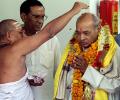
It is thanks to the policy of liberalisation conceived by Manmohan Singh and enforced by P V Narasimha that the Indian economy has now become the world's 5th largest economy by nominal GDP, asserts Dr Sudhir Bisht.
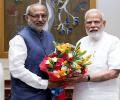
By naming a sworn swayamsevak for vice president, the Modi-Shah duo have sent out a clear and positive message to Nagpur, where the RSS headquarters is located, explains N Sathiya Moorthy.
The fourteenth Annual Conference on Indian Economic Policy Reform held at Stanford, California discussed the 'Economic performance of India's states'.
The list of departures from the path of economic reforms can be longer.

Cohn served as Trump's chief economic advisor since the beginning of the Administration. During his stay at the White House, he led coordination of Trump's pro-growth domestic and global economic policy agenda, including the passage of historic tax cuts and reforms in December 2017, the official said.
During the Congress regime, India did witnessa slew of reforms which are now taken up by the Modi government too.
Describing the pace of change in China as truly astounding and outstanding, Congress president Sonia Gandhi on Saturday said that India had much to learn from the way the Communist nation had approached economic reforms and liberalisation. Gandhi said the world today recognised the reality of an Asian renaissance and the re-emergence of China and India. She said that the two countries must work and prosper together as the world is big enough to accommodate the growth of both.
India has the capacity and the resilience to overcome economic crisis, Finance Minister Pranab Mukherjee said on Tuesday in the Rajya Sabha.

Finance Minister Nirmala Sitharaman's Budget proposals lay out a comprehensive road map for transforming India into a developed nation, focusing on key priorities that aim to generate ample opportunities for all citizens in "Viksit Bharat". It sets the stage for sustained economic growth, social development, and technological advancement.
'The demise of #ManmohanSingh ji who (looking back) presided over India's actual 'Acchey Din' feels like the end of an era when India was actually (more) democratic, when Indians were free(er) of fear & intolerance and when Indian public discourse had more decency.'

Budget 2025-26 delivers a carefully calibrated strategy-stimulating demand and investment while keeping fiscal discipline intact. In an environment marked by global trade disruptions, and a softening in urban consumption, Finance Minister Nirmala Sitharaman has taken a measured approach.

Finance Minister Arun Jaitley on Friday tabled the pre-Budget Economic Survey in the Lok Sabha.

There is a reason this 11 year phenomenon is a rule as much as it is an observation. It speaks to the nature of man and what humans are like, explains Aakar Patel.

Many were hoping that with Vajpayee's NDA gone, there would be a return to the Congress normal. Nobody was prepared for the opposite. Sonia Gandhi was sceptical. This became the only issue over which Manmohan Singh took on his party bosses and risked his government. Politically, it was riskier than the 1991 reform, recalls Shekhar Gupta.

'He may respect others, but he is unlikely to admire them'

Economist Deepak Nayyar says economic openness, while necessary, is not sufficient, and is conducive to development only when combined with industrial policy.
'We are worried for the workers because in the private sector, jobs are not secure, there is no decent work condition and there is no social security.' 'That's why we are opposing the economic policies of this government.'

'Surgical strikes or air strikes, or both, are likely on the table.'
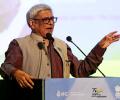
Debroy's economic interests and research work covered numerous areas such as economic theory, income inequality, and infrastructure financing.
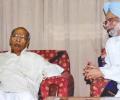
'Those who are talking of adopting the Narasimha Rao-Manmohan Singh policy must understand now that what was a reform then is no longer a reform now,' argues Sukumar Mukhopadhyay who was associated with the 1991 economic reforms.
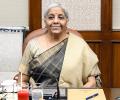
While the capital spending is being maintained at 3.1 per cent of the GDP, a little more would have boosted economic growth even further, suggests Rajiv Memani.

'As the global economy undergoes significant transformations in 2025, India's ability to navigate the complexities of trade wars, financial realignments, and emerging blocs will be pivotal,' explain Harsh V Pant and Soumya Bhowmik.
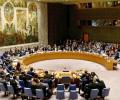
Pakistan was waiting for an opportunity to bring the Jammu and Kashmir issue to the global agenda and resorted to the terrorism route to provoke India, observes Ambassador T P Sreenivasan.

This will be the first full-year Budget of the BJP-led National Democratic Alliance government since it came to power for a third consecutive term in July last year.

Onno Ruhl said it is imperative to have a favourable global environment in addition to the domestic advantages.
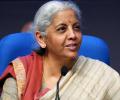
'If the BJP detoxifies the nuclear liability law, it will bring economic, environmental and, most of all, strategic benefits.' 'Let's keep our fingers crossed and hope that this Budget promise is met soon -- ideally, before Mr Modi heads to his first meeting with Trump 2.0,' observes Shekhar Gupta.
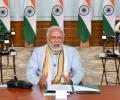
Whether it took the corona crisis to bring about the transformation, or otherwise, the change ought to be welcome, notes Virendra Kapoor.
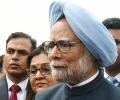
Condolences have poured in from across the globe, including from the United States, Canada and Sri Lanka following the demise of former Prime Minister Manmohan Singh.
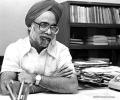
What stood out in his 15-year journey as a member of the political executive at the Centre was his glowing record as India's most successful and effective finance minister. Both as prime minister and finance minister, he understood the importance of gradualism, except when the economy or the polity was in a crisis.
